 |
| Sweetness, love and trust meets composure, hesitation and deceit. Is that what makes this picture so unforgettable?
"You affect me like a tonic". Says Claude Rains to Ingrid Bergman in Hitchcock's Notorious, and, of course, we feel exactly the same. We are just as infatuated with her as he is, although we also know that she is only pretending, playing a dangerous game as a double agent.
She has that wonderful way of offering him her cheeks, not in a real kiss, but more of a perfect cinematic kiss, the one that starts with a long look from someone whose face we can't see, is carried on to a plane where she blocks his view in order to get a better look out of the window, and further to the balcony scene, where the embrace is being both interrupted and prolonged by a telephone call.
Of course it is not Claude Rains who benefits from all this. It's the stone cold Cary Grant, down playing every move and line as if he were sleep walking through the film. And the colder he gets, the more she loves him, as if her mission was to warm up the North Pole.
Poor Claude Rains. He can't do anything to untie the bond between Ingrid and Cary, even though he is the one who marries her. And when she does embrace him, it is only to take his keys so she can help Cary get the MacGuffin. But the way Claude looks at her at the races, when she tries to hide her tears. and after they have kissed in the shadows at the party, is heartbreaking.
It's about lost love and love that can never be - and although it ends with Ingrid getting rescued and carried away in Cary's arms, there is a prevailing feeling of tragedy. Sometimes love comes too late, or is just not relevant enough. I believe this is something that both Hitchcock and Bergman knew - and probably Grant too.
Still I keep loving this movie like a fool, just as Claude Rains adores Ingrid. And there is some comfort in how that feeling prevails: I am just as touched today as I was thirty years ago, when I saw Notorious for the very first time.
|
söndag 2 augusti 2015
No summer without Hitchcock

lördag 30 maj 2015
Modern Bluebeard

Many of you, and I myself, will feel the need to answer this statement right away with: But isn't that just what life is about for everyone? Men and all creatures alive are just as much victims of the threats mentioned above. The men go to war, for one thing, where they might escape harassment, but certainly will face both mutilation and violent death. Why put the word sexual in front of oppression that threatens us all? Shouldn't we try and find ways to escape together, men and women as well as all creatures alike?
OK, we can go down that road, but not this time. I am thinking of Alex Garland's Ex Machina. It's a beautiful film. It's the kind of film that will stay with me for a long time, and rewind itself in my memory, reworking my thoughts on it and reshaping itself, as time goes by. I only wish I had seen it on the big screen - but for reasons unknown it never reached the cinemas in my country Sweden.
It's a story of a modern Frankenstein - or a modern Bluebeard. Or both.

So he builds women. And he keeps them in lonely house out in the wilderness. He has a Japanese sex toy slash house keeper - her name is Kyoko. And he has a guest - a man hand picked from civilization - who comes there thinking he won a competition. And the prize is to meet the most ultra modern thing: a robot shaped as a lovely young woman. Her name is Ava.
The test - the Turing test - is the films's MacGuffin. The two men talk about it as a test of whether Ava is a conscious robot or not, whether she has feelings, wheteher she can manipulate men... But who cares what the out come of the test is? Of course she can do all those things. Of course she can feel, think and plan ahead. And of course she can fool both of them.
The charm of this film is how it builds on all the stories in Western culture about man and woman, man trying to play God and the creature running amok, man being punished for his vanity. The interesting thing here, is how Frankenstein meets Bluebeard - and how he, the master mind, the genius, the creator of AI, in the end looks like just another pervert, a man who hates women so much he has to keep them locked up.

There are a lot of doors and windows in this film. The first time we meet Ava, through the eyes of the male guest, is also through a window pane. She is locked up in a large glass cage, like an animal in a zoo. And the test that is to be performed will have to take place with a glass wall between them. It reminds me of the glass between Hannibal Lecter and Clarice Starling. There, in The Silence of the Lambs - the glass made sense, but here, why does Ava have to be locked up?
Her name is Ava, and of course it is in honour of Ava Gardner, the beautiful movie star. In a way it's very clever. Ava was a movie star, but what was she really? In her films she always seemed unreal, an angel or a godess who just happened to get caught in front of a camera. Ava Gardner was also a public figure, someone who was made to sell magazines and cover stories. In those stories she was never the struggling artist, a rebel or a feminist. Not even when she told her own story, in her memoirs, did she let us know anything that we didn't already know: that she was a Southern belle who got lucky and liked to party.

In Ex Machina, Alex Garland and Alicia Vikander imagine another fate for Ava, the perfect unreal woman. In the end, when the guest opens all the hidden doors and discovers all the women before Ava, we get to understand why, in the beginning, there was a glass with a great crack in it. One of them tried to get away and failed. Ava will be the one who will succeed.
So how does Bluebeard's wife get out of the castle? How does the mad woman in the attic - or the bunker - get away? She uses her power over men: her beauty, her allure and mystical appearance - and her intelligence. And how does she do it? She talks to the man, the male guest, and she plants doubt in his mind.
Doubt is something that both men can't handle: Bluebeard drinks himself into a constant stupor, and takes the knife in the back and heart as if he were expecting it. The guest transforms his doubt into the action that will liberate Ava. The beauty of the story is that the doubt will linger on after she is gone: Why didn't she save Kyoko or the guest? Did she really need the guest? Couldn't she have unlocked the doors of her prison by herself, considering that she orchestrated the power cuts in the bunker?
But those questions are not important.
What is interesting is how Alicia Vikander changes in the film, from a prisoner in a half finished body in a place that looks like a space ship, to a woman in a white dress and long brown hair, very confident of herself, entering reality. In the beginning, she looks like a hesitant deer, stepping quietly into a clearing. Or she sits on the floor, very subordinate and obeying. In the end, after the story has followed its predictable, but none the less fascinating path, she enters the green wilderness like an actress on stage, determined and in awe of the magic she is capable of. Who is Ava? Does it matter? She is a force of her own, a force that will endure.


And that is important. That is what I believe make this film so alluring - and why women will continue to use their beauty and their sexual power in order to trick their prison guards and get away. And why they will continue to do so, in the name of all those who can't.
"All that being said, depending on the reading of this film, it may be one of the most feminist films I’ve seen in theaters in years. "
http://fandomsandfeminism.tumblr.com/post/118054555579/can-a-narrative-transcend-its-characters-ex
lördag 16 maj 2015
What a lovely day!
 |
| Charlize in Cannes with Sean. |
Or rather, she is a knock out. From her first moment on screen, with her anguished look, shaven head, forehead painted black, making the eyes glow like diamonds in a deep cave.
And of course, she can't be bad. She can't be one of those ugly, vulgar, death wishing men painted in white and silver, posing in scary masks or strumming a crazy guitar strapped on to the grotesque vehicles thundering down the roads to nowhere, screaming silly things like "witness this" before they go.
She, with the ridiculously stellar name of Imperator Furiosa, is a saviour, on the run from all those hellish men, with a cargo full of beautiful young women, all dressed in white like vestal virgins - although they are the wives of the crazy king in a citadel filled with ghostlike figures and slaves - all vaguely reminiscent of the monster city in Fritz Lang's classic Metropolis.
She is their saviour, and of course, she reminds me of other great screen females on the run: Linda Hamilton as Sarah Connor in Terminator 2, Susan Sarandon and Geena Davis in Thelma and Louise, Sigourney Weaver as Ellen Ripley.
Dazed and confused after seeing the film last night in one of the oldest and most beautiful cinemas of Stockholm, I didn't really get it until I read a tweet by Swedish fantasy writer Sara B Elfgren: "Mad Max: Fury Road is one of the most beautiful things I've seen."
The way she walks, with her left arm hanging with the lower part of her arm and hand missing. The way she talks, just like Humphrey Bogart, not a syllable goes to waste. The way she raises her good arm to shoot and then leaves the wheel, crawling under the big steel belly in motion, to fix something. The way her eyes silently give away the message that she will save not only the girls in the back, but all of us. She certainly will, that's what she promises Tom - or Max - in the end.
All she needs to do is to nod.


söndag 3 maj 2015
"He was some kind of a man"

With Orson Welles birthday coming up - he would have been 100 years old had he lived to May 6th 2015 - it is tempting to try and sum up what the great man was - and why Citizen Kane still is considered one of the best films ever made.
I have spent a few evenings with his films, both the ones he loved and hated - and I've browsed through some of the books about him - there are so many!
Who was he? Was he a genius or just a spoiled kid with a gigantic ego? What are his real contributions to cinema, when it seems that he preferred the theatre and probably loved the magic show more than anything else? And can we trust anything he said, really?
Among the texts, I particularly like the essay on Citizen Kane by Laura Mulvey in the BFI Film Classics. Mulvey is both a feminist and a Freudian and she provides clear cut readings on some of the things in the film that are not so obvious, such as the roles of women in Citizen Kane.
The other text is the lovable and very readable My lunches with Orson - conversations between Henry Jaglom and Orson Welles edited by Peter Biskind. The stories he tells, and how he tells them, how Jaglom feeds him his cues and how his reactions are subtly recorded, is just plain beautiful writing. It reminded me of how filmmaking also is a team effort, even when the star steals the show.
Of course, the interviews with Peter Bogdanovich are also great, but I almost prefer a clip from youtube, with Bogdanovich from a couple of years ago, now the older man, now the story teller, doing Orson impersonations during a presentation of Touch of evil at an American college. He is carrying Orson's torch now, and doing it with uncanny splendour.
And then there is a little movie called Orson and me. It was made in 2008 by Richard Linklater on the Isle of Man, maskerading for New York in 1937, when Orson Welles was staging Julius Ceasar with the Mercury Theatre - as a play about a fascist dictator. Christian McKay plays Orson Welles and he had previously played Orson in a one man show called Rosebud. His take on Orson is both fun and a little bit scary, at least for the stagestruck kid in the movie played by Zac Efron. It's great to see the big man alive again in a story that may very well have happened.
In Tim Burton's Ed Wood, from 1994, there is also a scene where Orson Welles turns up in a bar, to comfort and inspire the ambitious but not so genius Ed Wood. Orson Welles is played by Vincent D'Onofrio who looks a lot like Welles, and sounds like him too.
A few years later, in Peter Jackson's Heavenly Creatures, Orson is the object of desire, together with Mario Lanza, that propels two school girls into a fantasy world that eventually leads them to murder. Here, the apppearance of Orson Welles is in the shape of actor Jean Guérin.
He liked to talk, and to mesmerize people. He wasn't always truthful and he couldn't be trusted. He had a knack for abandoning his ideas, his projects, his beloved, and still he is famous for achieving some of the most memorable movies of the 20th century. It often seemed that he was the character he played, Kane, Mr Rochester, Harry Lime... Or that his appearances on the screen somehow gave us a new piece for the great big puzzle that was Orson Welles. He was fascinating, he was fun, he was charming and he had some things to contribute on the subject of personal integrity, power and corruption.
I'll rememeber him fondly. But, as his old friend Marlene Dietrich said in Touch of evil:
"What does it matter what you say about people?"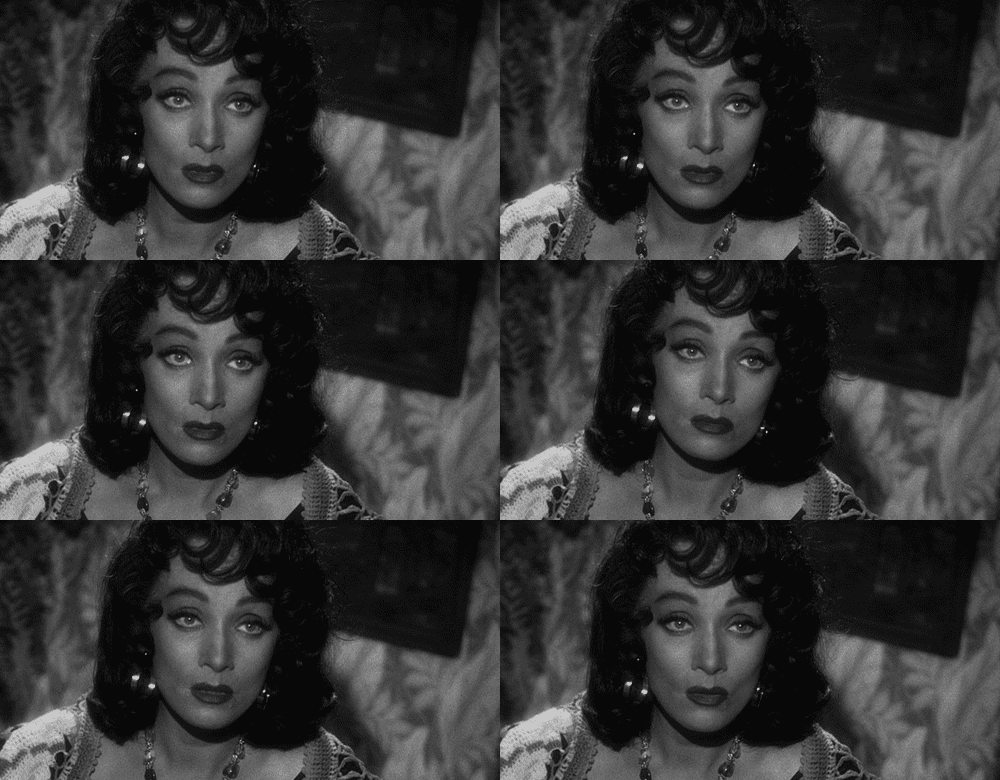
söndag 22 februari 2015
Nothing personal
 |
| How did this guy... |
 |
| ... become this guy?
An actor's job is to change his appearance. I understand that, and that is also part of the marvels that actors can do, and why we watch them. But sometimes they do things to themselves that go beyond the believable and that is really scary. Christan Bale lost so much weight he looked like he would disappear in The Machinist. Now Jake Gyllenhaal has managed to do something just as amazing - and horrible: The sympathetic cartoonist turned detective, the father who got hooked on The Zodiac and couldn't stop looking for the most dangerous man... The man whose eyes seemed to mirror all the pain and sadness in the world where evil lurks in so many forms...
Now he has turned himself into Lou Bloom, a hollow man, a cartoon of a man, a man masquerading as a man, repeating slogans and HR-jiberish as if they really meant something, but with only one real purpose: to get you. It's a tour de force in acting, but I doubt very much that Jake Gyllenhaal will win any Oscar for his part in the film Nightcrawler. It is just too scary - and too true.
The film critic Anthony Lane pointed it out before I saw the movie. This is from Lane's review in The New Yorker:
"The scariest thing about the new Jake Gyllenhaal film, “Nightcrawler,” is Jake Gyllenhaal. Or, to be precise, Jake Gyllenhaal’s eyes. They are sunk in their sockets. They have dispensed with blinking, and you can understand why; it would mean missing something important. They glare and they gleam, like the eyes of a man who is minutes away from death, furious with fever, and refusing to slip away in peace."
Yes, those eyes. But not only the eyes. It's the cheeks, the forehead, the way his nose looks bigger and the smile... It is scary enough when he holds his mouth closed, but when he opens it, he looks like a predator getting ready for the kill.
In Dan Gilroy's film, the nightcrawler is a parasite living on the misery of his fellow human beings. His name is Lou Bloom, but he has no human attachments, he lives alone in a tiny apartment, he has no family, no friends, no human contact outside his work. In the beginning of the film, we see him as a petty thief, stealing copper wires and beating a guard who asks him for his credentials - and then he steals tha guard's watch. By chance, he witnesses an accident, and how a camera crew for tv news films the accident, for a profit.
Lou Bloom decides that this should be his career.
At first, one could take Lou Bloom for one of those outsiders in society who has been unlucky on the battle grounds of career building and success. When he goes to a tv station and sells his first piece, he mentions a class he's been to, where he has learned how to get motivated when job searching. Actually he talks a lot like a text book for people getting started in their careers. But the talk becomes more and more scary because Lou Bloom doesn't use talk to get close to people. Verbal interaction for Lou Bloom (we never see him touch anyone physically, except for the guard in the beginning) is just a weapon in the fight for success. Lou Bloom talks to people only in order to gain control.
Lou Bloom made me first think of Travis Bickle, the disturbed taxi driver in Martin Scorsese's film. Obviously because of his incessant nightly cruising and antisocial beaviour. Or Norman Bates, the obsessive murderer with the sweet, boyish smile as Anthony Perkins played him in Hitchcock's Psycho. But these characters are very different from Lou Bloom in two vital aspects: they both have a back story that explains who they are, and they end up being caught in their own violent actions.
We know very little of Lou Bloom. He might have more in common with Patrick Bateman, the beastly yuppie of Bret Easton Ellis' famous novel American Psycho, and the film by Mary Harron - with Christian Bale.
Lou Bloom and Patrick Bateman both share a make believe personality. They are humans turned into robots, devoid of heart and feelings and normal, human reactions. To follow them around in their daily business is a horror experience in itself. These men don't react to other people unless there is a proper use in view - for them. They don't feel pain, shame, concern, guilt or anguish, and they don't know how to love or care for anyone else than themselves. The only feelings they do have, which has been pointed out by my husband, is greed and aggression.
In one particular scene in American Psycho, when Bateman is getting himself groomed for the day in his bathroom, he says one revealing line: "I am not here". Lou Bloom has a similar moment when he comments on the grisly material of violent death that he has just delivered to the tv station: "It looks more real on tv."
This refusal to be part of the world where the rest of us lives, with our sorrows and worries and loves and losses, is what makes Bloom and Bateman so scary.
They don't want any of this. But still, what they want makes them very dangerous to all of us. They will pursue their goal and let nothing stop them. They will kill you if you get in their way. Lou Bloom does it in a more subtle way, but he is just as dangerous as Bateman.
The horror of it all is that these people exist and live among us. And this is where Dan Gilroy's film becomes an urgent critic of our times, with his cleareyed view of our society where media feed on our blood lust and hyenas become heroes.
I am still in shock after seeing Nightcrawler, certainly one of the most important films made in recent years. I just hope Jake Gyllenhaal will find a way to get away from Lou Bloom.
|
söndag 8 februari 2015
Why do I love this film so much?
 |
| Rebecca Smart in Ann Turner's film Celia (1989)
I was a film critic in the eighties, or rather, I wanted to be one. In 1989, I went to the Gothenburg Film Festival, representing a small leftish weekly paper called Arbetaren. I saw a film called Celia, by Ann Turner. She was just a few years older than me, a film director living in Australia, and this was her first major feature film.
I was totally awe struck by Celia. I came home to Stockholm and told everyone I knew about it. I wrote two articles, and I waited impatiently for its Swedish release. I harrassed the buyer at the Swedish distributor Folkets Bio so much that he gave me a video copy of the film, which I cherished until it disappeared. I probably lent to someone.
Then, in 1993, Celia opened in Sweden, quietly and with not much success. At best it was seen as just one of those Indie films, made by one of those remarkable women directors from down under. I was very much surprised that the film did not rock anybody's world, at least not as much as it had mine. I also saw Ann Turner's second feature, a much bigger film with movie stars like Charlotte Rampling and a very young Russell Crowe. It was called Hammer over the Anvil, and I was a little disappointed. That film didn't leave me with any strong memories.
But Celia did.
Why did I love this film so much? The strange thing is that now, in these days, I could get it on dvd, or see it on Netflix or Youtube. I could probably see it whenever I want, just like all those other favorites that I keep close at hand. But Celia became a movie memory from the past. It was a film I loved very much - and forgot.
Then, suddenly, there is a new opportunity. Tomorrow I will see Celia again, at the Swedish Filminstitute where the Cinemathèque is reviving a series of films on the theme of childhood. I will go of course, happily sit back in the beautiful big cinema named after lengendary film director Victor Sjöström, and let myself be sunk into the film. But will I still love Celia? Will I see it with the same eyes that saw the film over 25 years ago, or have they changed, making me discover just another fraud, or simply, a case of changing taste?
So today - before I meet Celia again - I have to ask the question again: Why did I love this film so much?

The story is simple enough: Celia is a young girl with a very vivid imagination, living in south Australia in the late fifties. She is mourning her granny, who has recently died, and has nightmares about a monster called Hobiyah, that comes crawling out of a children's book to haunt her. Her parents give her a white rabbit which she names Murgatroyd. At the same time, a new family moves in next door to Celia's family. Then three things happen: the neighbours turn out to be communists - like Celias grandma, Celia's father has an affair with the neighbour's wife, and rabbits are declared vermine. Celia is forced to turn in Murgatroyd, who will be killed. Everything falls apart in Celia's world, and she turns on the local police man, killing him with her father's shot gun.

At imdb I read, quite astonished, that Celia was marketed as a horror film in the States. The writer comments on the absurdity of this choice too, and proposes another way to show Ann Turner's Celia off: in a double bill together with Heavenly Creatures, Peter Jackson's equally marvellous film about girls using fantasy to escape from an intolerant and narrowminded society - and ending up in violence.
Both these films could serve as ways to understand children becoming violent offenders. They could also be used as criticism of the weirdly British ways of people living on the other side of the planet - and the violence such attitudes and the denial of the real world around them entail. But why do I love this film Celia, having no experience at all of living in Australia in the fifties, being a child who has committed a crime, or even being denied a rabbit? I guess what struck me was a string of themes that are at the chore of this film: It's about the fakery of civilization, about parents who pretend to be "normal" while they are scared stiff to be exposed - in this case as communists. It's about betrayal and escape, Celia's escape into fantasy and getting caught in her worst nightmares. It's about being a child in a hostile world and being deprived of the only being with a promise of unconditional love: the rabbit. Those themes are envisioned in the story of the girl who loses her friend, and they grow strong and unforgettable in the magical scenery of the hot Australian summer, the dark nights when the Hobyahs come, and the fascinating face of a very small actress Rebecca Smart. Of course, what really happened was that I saw myself. I saw my own struggle to survive as a child surrounded by strange grown ups and mysterious, threatening mechanisms that I could only hope to grasp once I myself became a grown up. And to experience that, the film as mirror and dark alley back to my own memories, left a mark strong enough to stand out through the years. Not many films, books, songs or pictures have that kind of impact. What I also remembered were places, sounds and perfumes, the blue sky and strong sunlight over white, dusty buildings, balconies and open windows, the taste of tomatoes and garlic on fresh bread, cold orange juice and the taste of salt water on my body and my hair, the cold stone floors and houses painted in pastel flowers, the madonnas looking at me from their places above the doors, the mimosas in bloom, the sound of traffic outside our bedroom windows, the magic of these places and the fear of being left behind, of not finding my way, of being lost in paradise... Celia became a memory. someone I knew and loved, and someone who had also left me. I remember her fondly as I think of her from time to time. I am still a bit shaken about meeting her. I hope we will still be friends.  |
tisdag 6 januari 2015
Let my people go!
 |
| Christian Bale as Moses |
Also, Bale is famous for wanting to be a private person when he is not on the set. He is married and has a family, does no theatre acting at all and he has a temper, which at one time got him arrested in real life. He is soon to be 41 years old.
To his portrayal of Moses he brings violence and realism. Ridley Scott's Moses is a warrior and a killer. He shines in his silver armour, next to Joel Edgerton's Ramses - who wears gold - and is saved by Moses in the battle field. Later, when Moses finds out that he is Hebrew, his first reaction is to go out in the street and kill some Hebrews.
Why is this icon of patriarchal freedom played by a white male from England? Director Ridley Scott seems to have said something about the need for white, well known names in block buster movies. No one will go to see a film with actors called Mohammed - is what he is reported to have said. What a foolish thing to say. And so we have Englishman Joel Edgerton playing Ramses, John Turturro, a Jew from New York, playing the Pharao Seti, Ben Kingsley who is from India, plays Nun and Sigourney Weaver in a strangely small part.
There are however two actors in the film that could be there for the sake of realism: Bithia is played by Israelian actress Hiam Abbass and the Pharao's Grand Vizir is played by a famous actor-director from Syria called Ghassan Massoud.
It seems also that for the sake of realism, Moses is not seen as a baby being saved from the first massacre of babies by his mother, who puts him in a basket and lets the Nile transport him to the safety of the imperial princess Bithia. Maybe this scene was too much of fairy tale story for Ridley Scott. When we first meet Moses we see him as a young man struggling with his violent self. He only finds peace when he is banished to the the desert, where he is taken in by a group of shepherds, and finds his wife Sipphora (played by Spanish actress Maria Valverde). This Moses also talks frequently with a young boy, God's messenger, it seems, who urges him to go back to Egypt and free the Hebrews. The little boy leaves cryptic messages in the shape of small pyramids, made of cubic stones. I don't recall any of that from the Bible. But of course, my point of reference isn't really the Holy Scriptures but another film, Cecil B. DeMilles The Ten Commandments, from 1956, with Charlton Heston playing Moses. And that film was neither ethnically right nor realistic. But it was a film to remember.
When we get to the parting of the sea in Ridley Scott's film, it is strikingly realistic, more like a tsunami than an act of God. The sea just draws back, making way for the Jews, and then it comes back in full roar, to swallow up the Pharao's soldiers in a great wave. The images of horses and soldiers drowning look a bit like in The Ten Commandments, but this is the only time. Ridley Scott's Exodus doesn't compare itself at all to DeMille's grand opera of a film. Still, Scott's film doesn't lack the spectacular. In his film we get to see all the biblical plagues: the man eating crocodiles, the great frogs, the grasshoppers, the hail storms, the water that turns to blood and the worst: the killing of every first born child. In DeMille's film the waters turn to blood as by some magical painting, God himself coloring the waters red. And then there is a green cloud coming down from the sky, forming itself for a moment into a giant claw and then going on its murder spree, like a murderous fog. DeMille's film make spectacular use of color, movement and dramatic composition, drawing a lot of inspiration from the Bible illustrations by the French artist Gustave Doré. It is of course his Moses, and his dramatic imagery, that has inspired the older film. But what imagery has inspired Ridley Scott? His visuals in Exodus are grand, perhaps, but they stir no emotion, create no sense of awe.
 |
| Moses and the ten commandments the way Gustave Doré saw it. |
 |
| Now look at Charlton Heston as Moses: the way he is dressed, lit, his hair, his posture. |
Christian Bale also gets to age within the film, wear his hair in grey locks and walk heavily in his long robes as he keeps urging his people on. But Pharao Ramses as played by Joel Edgerton steals the show. He rivals Yul Brunner very well. They share the same sense of elegancy and melodrama, wearing beautiful costumes in shapely bodies. And he gets the best lines, talking to his first sleeping, then dead child, saying "You can sleep well because you know you are loved."
Ridley Scott's Moses never says the famous line "Let my people go!" I really missed those words, even though I can't be sure they are in the Bible. And I am sorry to say that Christian Bale lacks the grandeur and magnificence of Charlton Heston.
When we watch the old film at home, we realize what a master piece of an epic it is. The way Moses plunges to his knees, in front of the Pharao in the beginning, and reacts to the beautiful black princess who he has brought back with him from captured Ethiopia - making Anne Baxter as the Egyptian princess Nefertiri ooze with jealousy as she says: "And what a beautiful princess". The way they all pose in front of thrones and stones, in soft silks and fabrics that caress their skin, the way they wrap their arms around each other, in fond embrace - as when Moses says good bye to Bithia - or in amourous rage - as when Ramses holds his wife, Nefertiri. The way the pose as opera singers on a well lit stage, carefully recreating the pictures of Doré for the silver screen in bright technicolor. And the way the slaves struggle with the big stones in Egypt, and then walk through the desert, the Pharao's chariots chasing them and it's all true, not a single digitally manipulated frame here.
There are so many loose ends in Ridley Scott's film, although it lasts for over three hours, which to me has a very logical explanation: By next Christmas we will have the extended version, Exodus Redux. But this time the magic of CGI doesn't work. To see thousands of people walking through the desert, or working in the devilish pits of Egypt's slave system, is still and in the long run, best in reality, with real extras and not even a faint soupcon of digital tricks.
Cecil B. DeMille was never known to cheat his audience on the sense of awe, the feeling of being witness to something great. And this is sadly lost from Ridley Scott's Exodus and every other great digital epic done in our time.
My hope is that it can't last. The film epic has to change back to its former grand ways - or fall into oblivion.
Prenumerera på:
Inlägg (Atom)