tisdag 22 december 2015

Woman inherits the earth


The year 2015 in cinema has'nt exactly distinguished itself for a year living dangerously - despite all that is happening in our world. Rather, in cinema, and maybe that is a good thing, it has been a year of recycling. But what is is that has been recycled? During 2015, the following old blockbusters have reemerged on the screens:
Mad Max
Jurassic world
Mission Impossible
James Bond
Star Wars
Ghostbusters
Add to these the last part of the Hunger Games-series, the new Marvel film The Avengers and Fast and Furious 7. Plus a number of spoofs and copy cats on the above mentionend where I choose to name only one - for its feminist value -Spy.  

So what are the stories, ideas and eternal values that live on in these new takes on old blockbusters?

The growing critical acclaim of these films is an interesting case in point. The critics have especially loved the Mad Max film but also the bland James Bond and Mission Impossible where Rebecca Ferguson stole the show from Tom Cruise. She did it just as elegantly as Charlize Theron stole the show from Tom Hardy in Mad Max, and both actresses have to be given credit for reshaping the whole content of both films, making the patriarchal stability of the two films suddenly unstable. Unfortunately, the former film is still named after its male hero and the second - after seing a documentary about Tom Cruise's involvment in a religious sect I won't name, I´m sorry to say but I am not watching another Tom Cruise film again.

One eternal value in our western world is of course that of a man, a white male to be more precise, who will save the world - no matter what. One might ask oneself what makes it believable that the world will be saved by one such guy, and yet, it is obviously a very attractive idea in these times of many threats, both human and natural. 

Another enternal value, at least in the action film where all these blockbusters belong, is speed. In a way, the action film is becoming a celebration of things that must come to a pass: Soon we will have to face the consequences of our over mobile society. These action scenes often depend on a picturesque surrounding, preferably a famous place that we (the western audience) will recognize. So in Mission Impossible, we get to go to the Opera in Vienna, where a delicious game of assassins take place, while the opera is in full swing. James Bond drives his car at hallucinating speed in the streets of Rome, where the famous silhouettes of the Roman era stay safely on the curb, looking silently on. Mad Max was shot in the Namibian desert, where the exhuberant car chases have left marks and scars, for years to come.

The most attractive idea that all these films make us ponder on, is that man, everywhere on the globe, is in command. And his command is good, safe and eternal.

The James Bond film is called Spectre and calls for something like a "compte rendu" of previous evils. An existential problem hovers over the film, and that interested me. How is Bond to cope with the spectres of his old foes, all of which he meets in the end - but disappointedly enough only in the shape of pictures of all the old bad guys from previous films. I thought they were all coming back, in full shape, or at least in faked shapes, like when Laurence Olivier played Dr. Totenkopf in Sky Captain and the World of Tomorrow.

No, that would have been too much to ask from the producers of the Bond films. The only thing that seems to matter to them is to cram the picture with as much product promotion as possible - and to make Daniel Craig run convincingly in a suit. So, instead of becoming a reckoning on a global scale, Bond ends the film, as usual, walking away from the scene where he has defeated the bad guy, in a picturesque spot somewhere in old England. 

I walked away from the cinema feeling cheated after watching two hours of commercials. I do like to watch Daniel Craig, so I am not complaining about that. But why, if the money exists to travel across the globe and do some neat stunts in the snow as well as in Mexico and Morocco, why not hire a decent script writer too?
Oh, but the writers did work, one might say. What about all the fun references to films lika The Lady vanishes, North by Northwest and so on? Well.
In his wonderfully rich book on American cinema, The Cinema of loneliness, Robert Phillip Kolker writes: "contemporary filmgoers have become sophisticated in the complexities of popular culture. Indeed, the postmodern phenomenon depends upon reception-audience response. Postmodernity is, in part, the condition of living comfortably within the web of popular cultural references, of recognizing, perhaps, that Max Cady's finger tattoos that read "Love" and "Hate" come fron Charles Laughton's Night of the Hunter (1955) and adorned the fingers of Robert Mitchum, who also plays Cady in the first Cape Fear. What was once pedantry is now wisdom. /.../ But this is not complexity." 

Kolker is giving Martin Scorsese's Cape Fear a hard time in a chapter revolving around some of his greater films, like Mean Streets, GoodFellas and Casino. But Kolkers words work in this discussion too, in reference to the lazy tricks of some of this year's movie producers, when they seem to think that an identifiable nod to Hitchcock, or Kubrick, or someone else of bankable cinematic allure, will charm the audience.

A lot of films grow on their relationship to other films. There is even a genre I especially like, sometimes called "films about films" where classics like Sunset Boulevard and Singin' inte rain live. But in the case of this year's recycling of old cinematic ideas, I wonder what the thrill is really about.

Jurassic World might fare best of the lot, because everyone must love the idea of dinosaurs coming to life. But the new film is also the furthest away from its predecessors. That makes for interesting remarks: In the new film, there is a lovers quarrel going on while the dinosaurs run amok, like kids taking advantage of Mum and Dad fighting. The action is on an island filled with tourists who will eventually experience something rather horrible, like a tsunami, or a genocide. These are not things to take lightly, but the film does.

The discussion from the previous Jurassic films about nature against science, with the mad scientist claiming that he has "spared no expense" in making the place safe, is also totally gone. There isn't actually any old people around, like the character of Richard Attenborough with his famous stick in the first film, Jurassic Park. In Jurassic World, everyone is young and dating, or thinking about dating. 

In the first film, the couple of paleontologists played by Laura Dern and Sam Neill represented an interesting double agenda. The movie was just as much about exploring the idea of bringing dinosaurs back into the world, as making a "Mum" and "Dad" out of two egoistical people not yet ready to procreate on their own. Well, it was Sam Neill who was the egoist, while Laura Dern showed clear maternal instincts all along. 

In Jurassic World, I keep forgetting the dinosaurs, mostly enjoying the screw ball comedy between Chris Pratt and Bryce Dallas Howard, and especially enjoying her impressive stunts as a runner in high heels. What happened to the dinosaurs, the problem of science versus nature, the responsability of mankind in view of forces that he - or she - can't control?

I haven't seen the new Stars Wars or Ghostbusters, and not even the last part of the Hunger Games series, but there seems to be something going on here, something about force, speed and power being given to, or taken by, the females in the big mainstream, blockbuster film. What it means will have to be reflected upon. But it was foreseen already in the first Jurassic film, as proven by this delicious piece of dialogue:

Dr. Ian Malcolm: God creates dinosaurs. God destroys dinosaurs. God creates man. Man destroys God. Man creates dinosaurs.
Dr. Ellie Sattler: Dinosaurs eat man. Woman inherits the earth.


måndag 26 oktober 2015

Carol and Maud

Waiting for the last two big movies of the year: Suffragette and Carol, I find myself looking for two things in movies: love and sisterhood.

Early this year, I saw Céline Sciamma's Girlhood - or Bande à filles as is its original French title. Sciamma's film is about a young girl, Marieme (Karidja Touré) and her awakening to adulthood in the suburbs of Paris. The film starts with her leaving school, although she is a responsible daughter and eldest sister. Marieme gets involved with a group of "bad girls". She changes her name to Vic and engages in a series of small adventures, gradually getting further from her home and family and falling deeper into the black hole of young adulthood. All the while she is surrounded by indifference and violence, tired mums and dominant males, her only place of refuge being the sisterhood within the group of girls. 

What seems to me is that Sciamma is making her point very clearly: this is a film situated on a new wave. And what surprises me is that so few critics seem to have picked up on this. Because the film's title clearly alludes to a film from the famous nouvelle vague era: Bande à part by Jean-Luc Godard, made in 1965. That was a movie where the male outsider shone, just like in Francois Truffaut's melancholy Les 400 coups from a few years early, the film that inaugurated the new wave in 1959. Like so many other big divides in culture and history, those filmes were about how HE carries on in the world while SHE is something to use, to throw away if necessary, a toy at best. 

This new wave in contemporary cinema is about seeing people in the cracks of society, those that easily get fotgotten, and particularly those who are not white or male. 

What I like about Sciamma's film is that men are just as naturally ignored in Bande à filles as are women in the older French new wave. There is a scene where the girls, there are four of them, have stolen some clothes and get all dressed up. They are in a hotel room, enjoying the temporary luxury, and for a while I am afraid that they will do what girls normally do (in movies): they make themselves look nice so that men will want them. But instead, they stay in the hotel room and dance to a song by Rihanna. It's a lovely scene, filled with warmth and hope. Here is a group of young women who will make it together, finding strength and purpose in each other. Not as rivals in the battle over men, but as friends.

It gets complicated, of course, and friendship is tested. In the end, Vic is alone, standing outside her apartment, where her family lives. For a moment, it looks like she will be going back. But then she just walks out of the frame - and there the film ends. What will happen to Vic?

This ending reminds me of the end of Les 400 coups, the famous ending where Antoine Doinel (Jean-Pierre Léaud) has run away from correctional school and finally reaches the sea. Then he looks back at us, the camera, and the picture freezes. He is young and alone but strong and capable. His look is very fierce. 

Marieme is just like him. She is a new version of everything that we admired in Antoine Doinel. So I am sure: she will make it.

The same fierceness and the same cleareyed look on the world, and with it a refusal to surrender or be victimized by it, exist in another great film about sisterhood that I have seen this year: My skinny sister by Swedish film maker Sanna Lenken. 


My skinny sister is about the beautiful, successful Katja, who is close to becoming a skating star, and her little sister Stella, who is her opposite in everything. Katja performs beautfifully on the ice, and Stella watches in silent awe, her jealousy quietly growing. Stella tries very hard to be a ice skating queen too, and is told that she might do something else better. But she won't quit, besides, she is secretely in love with Katja's English trainer. Still, the sisters are very close, enjoying moments of teasing and laughter in their comfortable middle class home. So why does Katja get so ill? Why does she become anorectic and forces her sister to keep her secret until it is nearly too late?

My skinny sister doesn't answer the question why. It doesn't offer analysis or explanations about how or why a perfect young woman in a perfect world decides to starve herself to death. The film just shows us how a family goes to pieces. The beauty of the film is how it also presents us with clues to how the family hopefully will piece themselves together again - the main clues being love and sisterhood. 

And what is so beautiful is that the love that matters is the one between Katja and Stella - more than the parental love, or the hesitant nice reactions from school, friends or even Katja's trainer. The sisters meet in rivalry, anger, sadness, despair and joy. They stay close, no matter what, and it's this persistence, this strong bond between them, that I believe will eventually lead Katja to recover.

Of course, another thing that shines from this film is the marvelous performance by two very young actresses: Amy Deasismont playing Katja, and Rebecka Josephson playing Stella. Just like with Jean-Pierre Léaud and Karidja Touré, one watches these young faces with a sense of watching a miracle. The miracle of growing, of understanding what life is about. 

There have been some other great moments of sisterhood on the movie screen this year, like Spy and Mad Max and Still Alice - and yet another Swedish film: The Circle. But now, I'm waiting for Carol and Maud, the first is of course the film where Cate Blanchett and Rooney Mara fall in love, the second where Carey Mulligan plays Maud, a woman who becomes a Suffragette: "Cast off the shadow of yeaterday..."


söndag 2 augusti 2015

No summer without Hitchcock

Sweetness, love and trust meets composure, hesitation and deceit. Is that what makes this picture so unforgettable?

"You affect me like a tonic". Says Claude Rains to Ingrid Bergman in Hitchcock's Notorious, and, of course, we feel exactly the same. We are just as infatuated with her as he is, although we also know that she is only pretending, playing a dangerous game as a double agent. 

She has that wonderful way of offering him her cheeks, not in a real kiss, but more of a perfect cinematic kiss, the one that starts with a long look from someone whose face we can't see, is carried on to a plane where she blocks his view in order to get a better look out of the window, and further to the balcony scene, where the embrace is being both interrupted and prolonged by a telephone call.

Of course it is not Claude Rains who benefits from all this. It's the stone cold Cary Grant, down playing every move and line as if he were sleep walking through the film. And the colder he gets, the more she loves him, as if her mission was to warm up the North Pole. 

Poor Claude Rains. He can't do anything to untie the bond between Ingrid and Cary, even though he is the one who marries her. And when she does embrace him, it is only to take his keys so she can help Cary get the MacGuffin. But the way Claude looks at her at the races, when she tries to hide her tears. and after they have kissed in the shadows at the party, is heartbreaking. 

It's about lost love and love that can never be - and although it ends with Ingrid getting rescued and carried away in Cary's arms, there is a prevailing feeling of tragedy. Sometimes love comes too late, or is just not relevant enough. I believe this is something that both Hitchcock and Bergman knew - and probably Grant too. 

Still I keep loving this movie like a fool, just as Claude Rains adores Ingrid. And there is some comfort in how that feeling prevails: I am just as touched today as I was thirty years ago, when I saw Notorious for the very first time.


lördag 30 maj 2015

Modern Bluebeard


To be female in this world, is to suffer the threats of harassment, mutilation and violent death. As long as we are alive, a girl or a woman will have to live under the yoke of sexual oppression and that's just the way it is.

Many of you, and I myself, will feel the need to answer this statement right away with: But isn't that just what life is about for everyone? Men and all creatures alive are just as much victims of the threats mentioned above. The men go to war, for one thing, where they might escape harassment, but certainly will face both mutilation and violent death. Why put the word sexual in front of oppression that threatens us all? Shouldn't we try and find ways to escape together, men and women as well as all creatures alike?

OK, we can go down that road, but not this time. I am thinking of Alex Garland's Ex Machina.  It's a beautiful film. It's the kind of film that will stay with me for a long time, and rewind itself in my memory, reworking my thoughts on it and reshaping itself, as time goes by. I only wish I had seen it on the big screen - but for reasons unknown it never reached the cinemas in my country Sweden. 

It's a story of a modern Frankenstein - or a modern Bluebeard. Or both. 


So he builds women. And he keeps them in lonely house out in the wilderness. He has a Japanese sex toy slash house keeper - her name is Kyoko. And he has a guest - a man hand picked from civilization - who comes there thinking he won a competition. And the prize is to meet the most ultra modern thing: a robot shaped as a lovely young woman. Her name is Ava.

The test - the Turing test - is the films's MacGuffin.  The two men talk about it as a test of whether Ava is a conscious robot or not, whether she has feelings, wheteher she can manipulate men... But who cares what the out come of the test is? Of course she can do all those things. Of course she can feel, think and plan ahead. And of course she can fool both of them.

The charm of this film is how it builds on all the stories in Western culture about man and woman, man trying to play God and the creature running amok, man being punished for his vanity. The interesting thing here, is how Frankenstein meets Bluebeard - and how he, the master mind, the genius, the creator of AI, in the end looks like just another pervert, a man who hates women so much he has to keep them locked up.


There are a lot of doors and windows in this film. The first time we meet Ava, through the eyes of the male guest, is also through a window pane. She is locked up in a large glass cage, like an animal in a zoo. And the test that is to be performed will have to take place with a glass wall between them. It reminds me of the glass between Hannibal Lecter and Clarice Starling. There, in The Silence of the Lambs - the glass made sense, but here, why does Ava have to be locked up? 

Her name is Ava, and of course it is in honour of Ava Gardner, the beautiful movie star. In a way it's very clever. Ava was a movie star, but what was she really? In her films she always seemed unreal, an angel or a godess who just happened to get caught in front of a camera. Ava Gardner was also a public figure, someone who was made to sell magazines and cover stories. In those stories she was never the struggling artist, a rebel or a feminist. Not even when she told her own story, in her memoirs, did she let us know anything that we didn't already know:  that she was a Southern belle who got lucky and liked to party.  

In Ex Machina, Alex Garland and Alicia Vikander imagine another fate for Ava, the perfect unreal woman. In the end, when the guest opens all the hidden doors and discovers all the women before Ava, we get to understand why, in the beginning, there was a glass with a great crack in it. One of them tried to get away and failed. Ava will be the one who will succeed.

So how does Bluebeard's wife get out of the castle? How does the mad woman in the attic - or the bunker - get away? She uses her power over men: her beauty, her allure and mystical appearance - and her intelligence. And how does she do it? She talks to the man, the male guest, and she plants doubt in his mind. 

Doubt is something that both men can't handle: Bluebeard drinks himself into a constant stupor, and takes the knife in the back and heart as if he were expecting it. The guest transforms his doubt into the action that will liberate Ava. The beauty of the story is that the doubt will linger on after she is gone: Why didn't she save Kyoko or the guest? Did she really need the guest? Couldn't she have unlocked the doors of her prison by herself, considering that she orchestrated the power cuts in the bunker?

But those questions are not important. 

What is interesting is how Alicia Vikander changes in the film, from a prisoner in a half finished body in a place that looks like a space ship, to a woman in a white dress and long brown hair, very confident of herself, entering reality. In the beginning, she looks like a hesitant deer, stepping quietly into a clearing. Or she sits on the floor, very subordinate and obeying. In the end, after the story has followed its predictable, but none the less fascinating path, she enters the green wilderness like an actress on stage, determined and in awe of the magic she is capable of. Who is Ava? Does it matter? She is a force of her own, a force that will endure.

And that is important. That is what I believe make this film so alluring - and why women will continue to use their beauty and their sexual power in order to trick their prison guards and get away. And why they will continue to do so, in the name of all those who can't.

"All that being said, depending on the reading of this film, it may be one of the most feminist films I’ve seen in theaters in years. "

http://fandomsandfeminism.tumblr.com/post/118054555579/can-a-narrative-transcend-its-characters-ex


lördag 16 maj 2015

What a lovely day!

Charlize in Cannes with Sean.
It's hard not to fall in love with Charlize Theron. She really knows how to make an entrance, be it as hateful mankiller, evil queen, forsaken daughter or desperate driver in the post apocalyptic desert. I really thought I wouldn't go to see the new Mad Max movie, but I did, and I slowly realize that it's a knock out.

Or rather, she is a knock out. From her first moment on screen, with her anguished look, shaven head, forehead painted black, making the eyes glow like diamonds in a deep cave. 

And of course, she can't be bad. She can't be one of those ugly, vulgar, death wishing men painted in white and silver, posing in scary masks or strumming a crazy guitar strapped on to the grotesque vehicles thundering down the roads to nowhere, screaming silly things like "witness this" before they go.  

She, with the ridiculously stellar name of Imperator Furiosa, is a saviour, on the run from all those hellish men, with a cargo full of beautiful young women, all dressed in white like vestal virgins - although they are the wives of the crazy king in a citadel filled with ghostlike figures and slaves - all vaguely reminiscent of the monster city in Fritz Lang's classic Metropolis. 

She is their saviour, and of course, she reminds me of other great screen females on the run: Linda Hamilton as Sarah Connor in Terminator 2, Susan Sarandon and Geena Davis in Thelma and Louise, Sigourney Weaver as Ellen Ripley. 

Dazed and confused after seeing the film last night in one of the oldest and most beautiful cinemas of Stockholm, I didn't really get it until I read a tweet by Swedish fantasy writer Sara B Elfgren: "Mad Max: Fury Road is one of the most beautiful things I've seen."

The way she walks, with her left arm hanging with the lower part of her arm and hand missing. The way she talks, just like Humphrey Bogart, not a syllable goes to waste. The way she raises her good arm to shoot and then leaves the wheel, crawling under the big steel belly in motion, to fix something. The way her eyes silently give away the message that she will save not only the girls in the back, but all of us. She certainly will, that's what she promises Tom - or Max - in the end. 

All she needs to do is to nod.


söndag 3 maj 2015

"He was some kind of a man"

With Orson Welles birthday coming up - he would have been 100 years old had he lived to May 6th 2015 - it is tempting to try and sum up what the great man was - and why Citizen Kane still is considered one of the best films ever made.
I have spent a few evenings with his films, both the ones he loved and hated - and I've browsed through some of the books about him - there are so many!

Who was he? Was he a genius or just a spoiled kid with a gigantic ego? What are his real contributions to cinema, when it seems that he preferred the theatre and probably loved the magic show more than anything else? And can we trust anything he said, really? 

Among the texts, I particularly like the essay on Citizen Kane by Laura Mulvey in the BFI Film Classics. Mulvey is both a feminist and a Freudian and she provides clear cut readings on some of the things in the film that are not so obvious, such as the roles of women in Citizen Kane. 

The other text is the lovable and very readable My lunches with Orson - conversations between Henry Jaglom and Orson Welles edited by Peter Biskind. The stories he tells, and how he tells them, how Jaglom feeds him his cues and how his reactions are subtly recorded, is just plain beautiful writing. It reminded me of how filmmaking also is a team effort, even when the star steals the show. 

Of course, the interviews with Peter Bogdanovich are also great, but I almost prefer a clip from youtube, with Bogdanovich from a couple of years ago, now the older man, now the story teller, doing Orson impersonations during a presentation of Touch of evil at an American college. He is carrying Orson's torch now, and doing it with uncanny splendour.

And then there is a little movie called Orson and me. It was made in 2008 by Richard Linklater on the Isle of Man, maskerading for New York in 1937, when Orson Welles was staging Julius Ceasar with the Mercury Theatre - as a play about a fascist dictator. Christian McKay plays Orson Welles and he had previously played Orson in a one man show called Rosebud. His take on Orson is both fun and a little bit scary, at least for the stagestruck kid in the movie played by Zac Efron. It's great to see the big man alive again in a story that may very well have happened. 

In Tim Burton's Ed Wood, from 1994, there is also a scene where Orson Welles turns up in a bar, to comfort and inspire the ambitious but not so genius Ed Wood. Orson Welles is played by Vincent D'Onofrio who looks a lot like Welles, and sounds like him too.

A few years later, in Peter Jackson's Heavenly Creatures, Orson is the object of desire, together with Mario Lanza, that propels two school girls into a fantasy world that eventually leads them to murder. Here, the apppearance of Orson Welles is in the shape of actor Jean Guérin.  

He liked to talk, and to mesmerize people. He wasn't always truthful and he couldn't be trusted. He had a knack for abandoning his ideas, his projects, his beloved, and still he is famous for achieving some of the most memorable movies of the 20th century. It often seemed that he was the character he played, Kane, Mr Rochester, Harry Lime... Or that his appearances on the screen somehow gave us a new piece for the great big puzzle that was Orson Welles. He was fascinating, he was fun, he was charming and he had some things to contribute on the subject of personal integrity, power and corruption. 

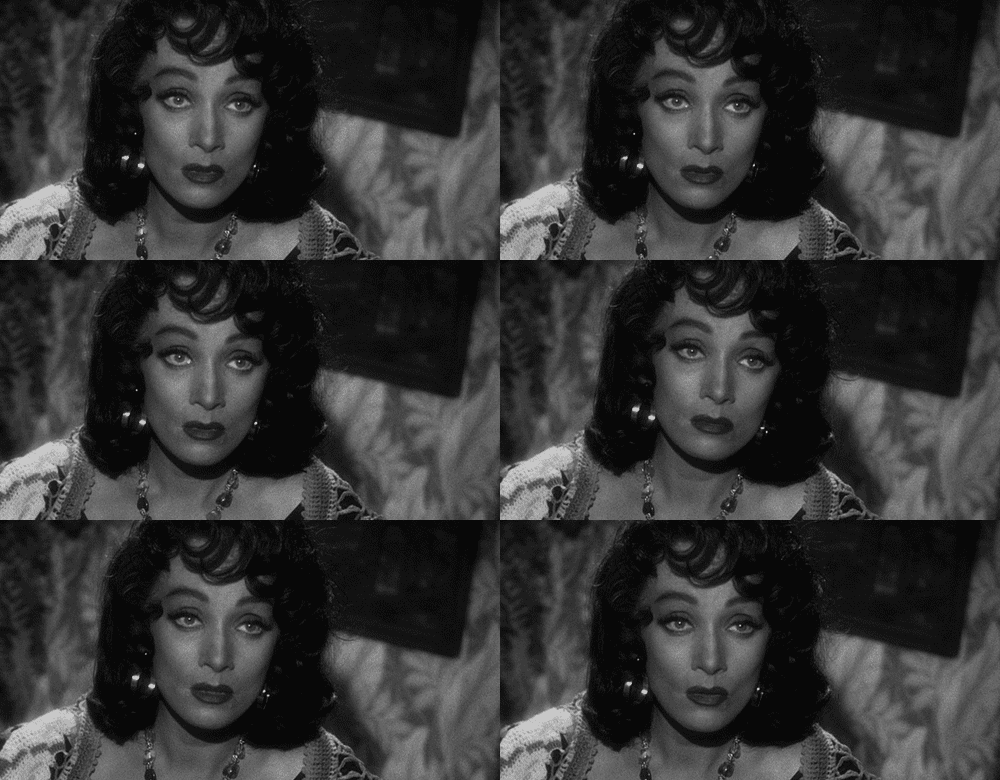
I'll rememeber him fondly. But, as his old  friend Marlene Dietrich said in Touch of evil: 

"What does it matter what you say about people?"

söndag 22 februari 2015

Nothing personal


How did this guy...

... become this guy?

An actor's job is to change his appearance. I understand that, and that is also part of the marvels that actors can do, and why we watch them. But sometimes they do things to themselves that go beyond the believable and that is really scary. Christan Bale lost so much weight he looked like he would disappear in The Machinist. Now Jake Gyllenhaal has managed to do something just as amazing - and horrible: The sympathetic cartoonist turned detective, the father who got hooked on The Zodiac and couldn't stop looking for the most dangerous man... The man whose eyes seemed to mirror all the pain and sadness in the world where evil lurks in so many forms... 

Now he has turned himself into Lou Bloom, a hollow man, a cartoon of a man, a man masquerading as a man, repeating slogans and HR-jiberish as if they really meant something, but with only one real purpose: to get you. It's a tour de force in acting, but I doubt very much that Jake Gyllenhaal will win any Oscar for his part in the film Nightcrawler. It is just too scary -  and too true.

The film critic Anthony Lane pointed it out before I saw the movie. This is from Lane's review in The New Yorker:
"The scariest thing about the new Jake Gyllenhaal film, “Nightcrawler,” is Jake Gyllenhaal. Or, to be precise, Jake Gyllenhaal’s eyes. They are sunk in their sockets. They have dispensed with blinking, and you can understand why; it would mean missing something important. They glare and they gleam, like the eyes of a man who is minutes away from death, furious with fever, and refusing to slip away in peace." 
Yes, those eyes. But not only the eyes. It's the cheeks, the forehead, the way his nose looks bigger and the smile... It is scary enough when he holds his mouth closed, but when he opens it, he looks like a predator getting ready for the kill. 

In Dan Gilroy's film, the nightcrawler is a parasite living on the misery of his fellow human beings. His name is Lou Bloom, but he has no human attachments, he lives alone in a tiny apartment, he has no family, no friends, no human contact outside his work. In the beginning of the film, we see him as a petty thief, stealing copper wires and beating a guard who asks him for his credentials - and then he steals tha guard's watch. By chance, he witnesses an accident, and how a camera crew for tv news films the accident, for a profit.

Lou Bloom decides that this should be his career. 

At first, one could take Lou Bloom for one of those outsiders in society who has been unlucky on the battle grounds of career building and success. When he goes to a tv station and sells his first piece, he mentions a class he's been to, where he has learned how to get motivated when job searching. Actually he talks a lot like a text book for people getting started in their careers. But the talk becomes  more and more scary because Lou Bloom doesn't use talk to get close to people. Verbal interaction for Lou Bloom (we never see him touch anyone physically, except for the guard in the beginning) is just a weapon in the fight for success. Lou Bloom talks to people only in order to gain control. 

Lou Bloom made me first think of Travis Bickle, the disturbed taxi driver in Martin Scorsese's film. Obviously because of his incessant nightly cruising and antisocial beaviour. Or Norman Bates, the obsessive murderer with the sweet, boyish smile as Anthony Perkins played him in Hitchcock's Psycho. But these characters are very different from Lou Bloom in two vital aspects: they both have a back story that explains who they are, and they end up being caught in their own violent actions.

We know very little of Lou Bloom. He might have more in common with Patrick Bateman, the beastly yuppie of Bret Easton Ellis' famous novel American Psycho, and the film by Mary Harron - with Christian Bale. 

Lou Bloom and Patrick Bateman both share a make believe personality. They are humans turned into robots, devoid of heart and feelings and normal, human reactions. To follow them around in their daily business is a horror experience in itself. These men don't react to other people unless there is a proper use in view - for them. They don't feel pain, shame, concern, guilt or anguish, and they don't know how to love or care for anyone else than themselves. The only feelings they do have, which has been pointed out by my husband, is greed and aggression.

In one particular scene in American Psycho, when Bateman is getting himself groomed for the day in his bathroom, he says one revealing line: "I am not here". Lou Bloom has a similar moment when he comments on the grisly material of violent death that he has just delivered to the tv station: "It looks more real on tv."

This refusal to be part of the world where the rest of us lives, with our sorrows and worries and loves and losses, is what makes Bloom and Bateman so scary.

They don't want any of this. But still, what they want makes them very dangerous to all of us. They will pursue their goal and let nothing stop them. They will kill you if you get in their way. Lou Bloom does it in a more subtle way, but he is just as dangerous as Bateman. 

The horror of it all is that these people exist and live among us. And this is where Dan Gilroy's film becomes an urgent critic of our times, with his cleareyed view of our society where media feed on our blood lust and hyenas become heroes. 

I am still in shock after seeing Nightcrawler, certainly one of the most important films made in recent years. I just hope Jake Gyllenhaal will find a way to get away from Lou Bloom.